
Written by Howard Yeh
Co-Founder & Chief Revenue Officer at HealthCare.com
Compare Medicare Advantage and Medigap Plans That Fit Your Needs
You will be taken to

to finish your submission.
What You Need to Know
- Medicare Supplement plans, also known as Medigap, help pay for out-of-pocket costs not covered by Medicare Part A and Part B.
- Connecticut insurance companies must accept your Medicare Supplement (Medigap) plan application if you’re in your Medigap Open Enrollment Period or have guaranteed issue rights.
- The three most popular Medigap policies are typically Plans F, G, and N.
Medigap in Connecticut for 2027: what to know
- Switching plans: Connecticut requires continuous guaranteed issue. You can buy or switch Medigap plans any time of year without medical underwriting.
- Best time to buy: your 6-month Medigap Open Enrollment Period, which starts the month you are 65 or older and enrolled in Part B. Insurers must sell you any plan they offer at their best available rate, regardless of your health.
- 2027 amounts: High-deductible Plans G and F have a $3,050 deductible. Plan K’s out-of-pocket limit is $8,360 and Plan L’s is $4,180.
- Free help: Connecticut’s Program for Health Insurance Assistance, Outreach, Information and Referral, Counseling, Eligibility Screening (CHOICES), 1-800-994-9422.
What Are Medicare Supplement Plans in Connecticut?
Medicare is a federal health insurance program for individuals aged 65 and older, as well as younger people with qualifying disabilities or health conditions (e.g., end-stage renal disease).
Original Medicare, which includes Part A (Hospital Insurance) and Part B (Medical Insurance), covers many healthcare services. However, it still leaves you with out-of-pocket costs like deductibles, coinsurance, and copayments. Medicare Supplement plans help pay for these expenses.
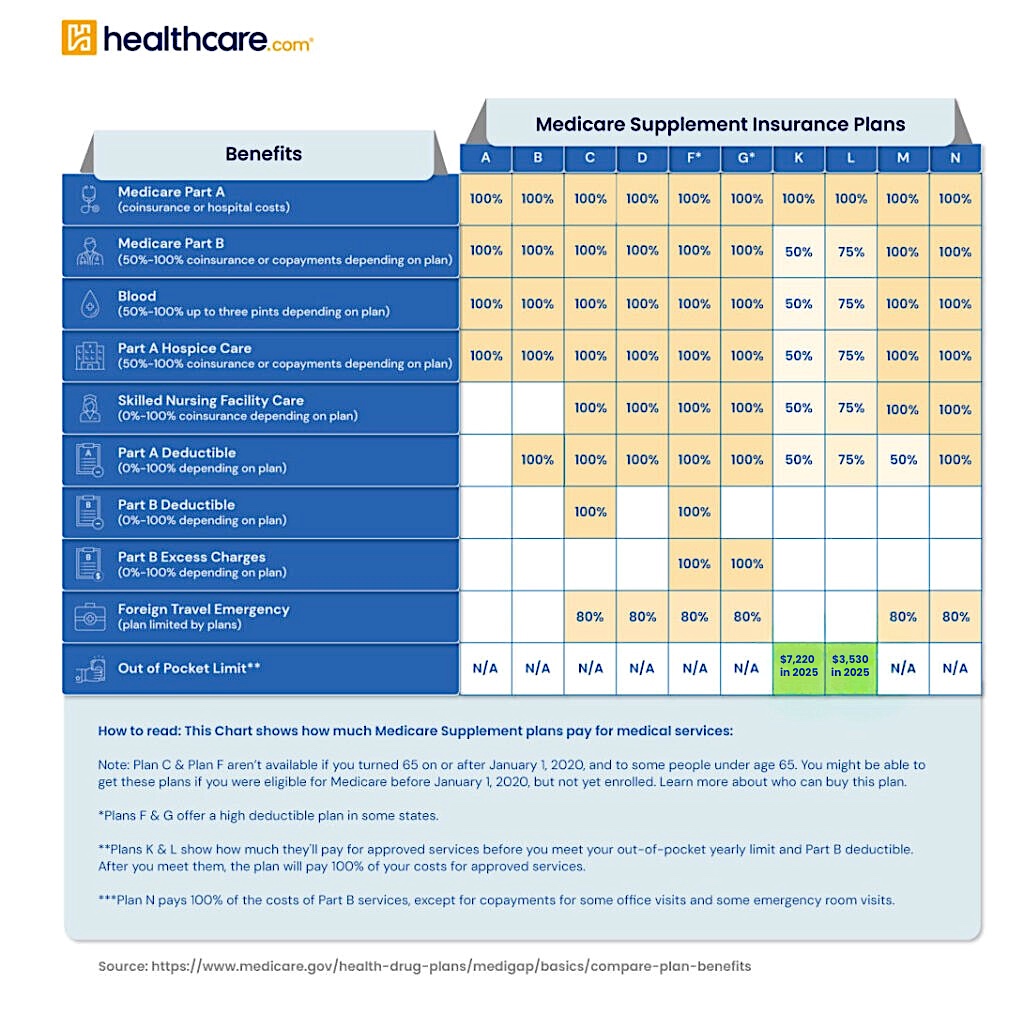
In Connecticut, you can choose from 12 Medigap policies, including two high-deductible options. Medigap plans are standardized by letter (A through N). That means Plan A from one company offers the same benefits as Plan A from another, though premiums may differ.
Learn how these plans work and how they benefit residents of Connecticut.
Compare options HERE & start your health plan journey.
When Can You Enroll in a Medicare Supplement (Medigap) Policy?
You can apply for a Medigap plan at any time. However, outside of your Medigap Open Enrollment Period, or without guaranteed issue rights, insurers may use your health history to deny coverage or charge higher premiums.
Your Medigap Open Enrollment Period lasts for six months. It begins automatically when you are both age 65 or older and enrolled in Medicare Part B. During this time, insurance companies must offer you any plan they sell at standard rates, regardless of your health.
This is the ideal time to enroll because it gives you the widest choice of plans and the best rates.
Certain life events can also trigger guaranteed issue rights, such as losing employer coverage or your Medicare Advantage plan ending. In those cases, insurance providers must offer you coverage and cannot charge more due to your health.
Unlimited Open Enrollment: Medicare supplement plans are not underwritten year-round. All plans are available in guaranteed issue situations.
What Are the Most Popular Medicare Supplement Plans?
Nationwide and in Connecticut, the most commonly selected Medigap plans are:
- Plan F: Offers the most comprehensive coverage, but is only available to those who became eligible for Medicare before January 1, 2020.
- Plan G: Offers nearly the same coverage as Plan F, excluding the Medicare Part B deductible.
- Plan N: Covers many core benefits but includes copayments for some doctor and ER visits, and does not cover Part B excess charges.
All Medigap plans with the same letter offer identical benefits, regardless of the insurer. The difference lies in the premiums and company reputation.
How Do You Choose a Medicare Supplement Plan?
To choose the right Medigap plan, consider:
- Your healthcare usage: Look at how often you visit doctors or specialists and what services you typically use.
- Your budget: Decide whether you prefer higher monthly premiums with fewer out-of-pocket costs (like Plan G), or lower premiums with more cost-sharing (like Plan N).
- Future needs: Choose a plan that supports your long-term health goals and anticipated expenses.
You can compare plans online or speak with a licensed insurance agent for personalized guidance.
When comparing, be sure to look at:
- The plan letter (e.g., G or N)
- Pricing methods used by insurers (attained-age, issue-age, or community-rated)
- Customer service reputation of the insurer
How Much Do Medigap Policies Cost?
Medigap premiums in Connecticut vary based on several factors:
- Age and gender
- Tobacco use
- Plan type
- Pricing method used by the insurer
While benefits are standardized, the monthly premium can differ significantly between companies and locations. Always compare the same plan (e.g., Plan G vs. Plan G) across different insurers for a true cost comparison.
What If You Want to Change Your Medicare Supplement Plan?
You can apply to change Medigap policies at any time. However, unless you have guaranteed issue rights or qualify for a Special Enrollment Period, insurers may review your medical history and deny you coverage or increase your rates.
That’s why it’s crucial to choose the right plan during your Medigap Open Enrollment Period. If you do need to make changes later, speak with an agent to understand your options and whether you qualify for special protections.
Compare options HERE & start your health plan journey.
What Are Alternatives to Medicare Supplement Plan?
Medicare Advantage plans, also known as Medicare Part C, are an alternative to Original Medicare. These plans are offered by private insurance companies and bundle Medicare Part A and Part B, often with Part D (prescription drug coverage) included.
Many Medicare Advantage plans also offer extra benefits like:
- Dental
- Vision
- Hearing
- Fitness memberships
Instead of paying for a Medigap plan and a separate drug plan, you can enroll in an all-in-one Medicare Advantage plan. However, Advantage plans typically use provider networks and may have higher cost-sharing if you go out of network.
Learn more about Connecticut Medicare Advantage plans.
Medicare Part D?
Medicare Part D plans offer standalone prescription drug coverage. Here’s what to know:
- Who needs it: If you’re enrolled in Original Medicare and want drug coverage, you need a separate Part D plan.
- What it covers: Prescription medications; specific drugs and prices vary by plan.
- How it’s offered: Through private insurers approved by Medicare.
- Not needed if: You’re already enrolled in a Medicare Advantage plan that includes drug coverage.
Shop for a Medicare plan with additional benefits!
Do Medigap Plans Cover Prescription Drugs?
No. Medigap plans do not include prescription drug coverage. If you have Original Medicare and want drug benefits, you’ll need to purchase a separate Part D plan.
Medicare Resources in Connecticut
Connecticut residents have access to several helpful programs:
- CHOICES (Connecticut’s SHIP program): Offers free, personalized counseling and educational outreach to Medicare beneficiaries and their families.
- Connecticut Insurance Department: Provides consumer assistance, complaint resolution, and information on approved insurers.
- HUSKY Health (Connecticut’s Medicaid program): Includes Medicaid and CHIP. It offers healthcare coverage for qualifying low-income residents and can coordinate with Medicare benefits.
Next Steps
If a Medicare Supplement plan in Connecticut fits your needs, take the next step by comparing plan options in your area. You can browse plans online or speak with a licensed insurance agent to get help selecting the right coverage for your health and financial goals.
Frequently Asked Questions
Can I switch Medigap plans in Connecticut without health questions?
Connecticut requires continuous guaranteed issue. You can buy or switch Medigap plans any time of year without medical underwriting.
When is the best time to buy a Medigap plan in Connecticut?
During your 6-month Medigap Open Enrollment Period, which starts the month you are 65 or older and enrolled in Medicare Part B. During that window, insurers must sell you any Medigap plan they offer at their best available rate, regardless of your health.
What are the 2027 amounts for Plans K, L and high-deductible G?
For 2027, Plan K’s out-of-pocket limit is $8,360 and Plan L’s is $4,180. High-deductible Plans G and F have a $3,050 deductible.
Where can I get free Medicare help in Connecticut?
The Connecticut’s Program for Health Insurance Assistance, Outreach, Information and Referral, Counseling, Eligibility Screening (CHOICES) offers free, unbiased Medicare counseling. Call 1-800-994-9422.
Sources
- KFF, Medigap Guaranteed Issue Requirements: An Overview of Federal and State Rules (October 13, 2026)
- NAIC, State Medigap Rules: Birthday Rule and Coverage for Under 65 (May 11, 2026)
- CMS, Medigap Plan K and L out-of-pocket limits
- CMS, High-deductible Medigap plan deductible announcements
- Medicare.gov, Compare Medigap plan benefits
- SHIP National Technical Assistance Center, find your local SHIP
Last reviewed: November 2026. State Medigap rules can change, so confirm details with your state insurance department or SHIP before you switch. This article is general information, not personalized insurance advice.
We aim to help you make informed healthcare decisions. While this post may contain links to lead generation forms, this won’t influence our writing. We follow strict editorial standards to give you the most accurate and unbiased information.

U.S. Government Website for Medicare. “When Can I Buy Medigap?” medicare.gov (accessed February 12, 2021).
U.S. Government Website for Medicare. “Guaranteed issue rights.” medicare.gov (accessed February 12, 2021).
U.S. Government Website for Medicare. “Supplement Insurance (Medigap) plans in Connecticut.” medicare.gov (accessed February 12, 2021).